Muscle of the Week: The Infraspinatus (The Shoulder’s Silent Troublemaker)

If you have ever felt a deep, dull ache in the front of your shoulder that makes you want to dig your thumb into your joint, you might assume you have a rotator cuff tear or joint inflammation.
However, as a clinical massage therapist specializing in orthopedics and biomechanics, I frequently find that the true culprit is a small muscle hiding on the back of your shoulder blade: the Infraspinatus.
This post kicks off our new educational series exploring how functional anatomy dictates why we feel pain, and how targeted clinical therapy can resolve it.
Anatomy & Function: Where is it and what does it do?
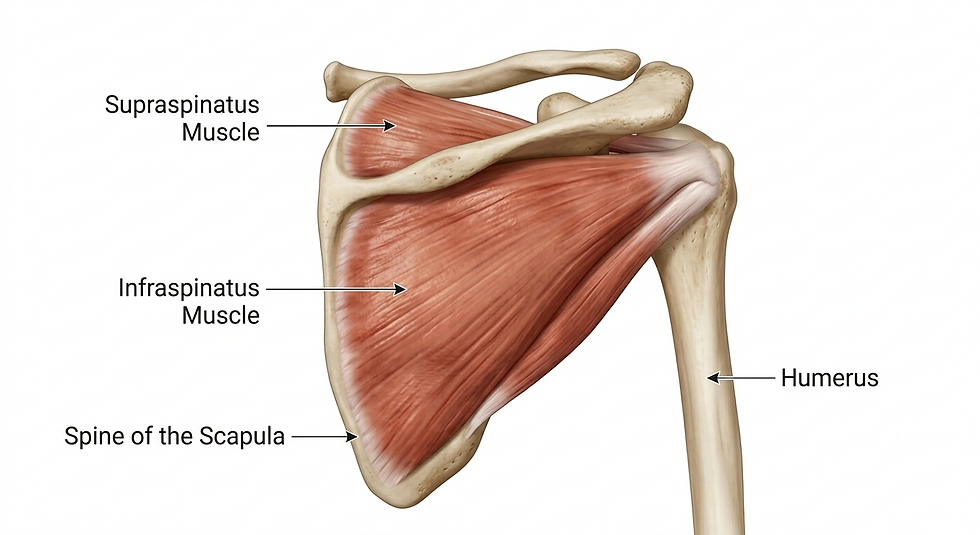
The Infraspinatus is one of the four muscles that make up your rotator cuff.
The Location: It occupies the infraspinatous fossa—the broad, flat surface on the back of your scapula (shoulder blade). It runs from the shoulder blade and attaches to the greater tubercle of your humerus (upper arm bone).
The Action: Its primary job is lateral rotation (externally rotating your arm, like when you swing a tennis racket back or reach into the backseat of your car). It also acts as a vital dynamic stabilizer, pulling the head of your humerus securely into the shoulder socket when you lift, push, or carry objects.
The Biomechanical Strain: How does it get irritated?
Because the infraspinatus continuously stabilizes the shoulder joint, it is highly susceptible to repetitive strain and overload. We see this frequently in:
Active Individuals: Kayakers, tennis or pickleball players, swimmers, and weightlifters who use repetitive overhead or rotational arm movements.
Postural Overload: Desk workers who sit with "rounded shoulders." When your shoulders slouch forward, the infraspinatus is placed under a constant, low-grade stretch (eccentric load) as it tries to hold your arm bone back. Over time, this leads to micro-tears and protective muscle guarding.
The Science of Referred Pain: Why your back hurts in the front
One of the most fascinating aspects of neuromuscular therapy is referred pain—pain felt in a part of the body other than its actual source. This happens because sensory nerves from different areas merge on the same pathways in your spinal cord, occasionally confusing the brain's "wiring."
The Infraspinatus is famous for this. When myofascial trigger points (hyper-irritable taut bands of muscle fibers, commonly known as knots) develop in this muscle, they rarely cause pain on the shoulder blade itself.
Instead, the classic Infraspinatus Referred Pain Pattern projects:
Deeply into the front of the shoulder joint (anterior deltoid region).
Down the lateral side of the arm into the biceps and forearm.
Occasionally radiating into the radial side of the hand and fingers.
The Clinical Reality: Many people spend months treating the front of their shoulder with ice, topicals, or stretching, wondering why the pain won't budge. The tissue is irritated in the front, but the mechanical dysfunction is originating entirely from the back.

The Clinical Approach to Relief
Because the infraspinatus sits beneath thick layers of fascia and adjacent to other critical rotator cuff structures, general relaxation massage is rarely enough to resolve chronic issues. To safely and effectively address this dysfunction, a skilled clinical therapist will utilize a customized combination of myofascial release, targeted trigger point therapy, and advanced neuromuscular techniques to release the restricted tissue, calm the nervous system, and restore proper biomechanics.
If you are currently experiencing the deep, nagging shoulder ache or referred arm pain we discussed in this post, you don't have to just live with the discomfort or wait for it to get worse. Click below to schedule a targeted clinical assessment and therapy session so we can get to the root of the issue and get you back to moving pain-free.
Works Cited
Kwon, Junbeom, et al. "Characteristics of Myofascial Pain Syndrome of the Infraspinatus Muscle." Annals of Rehabilitation Medicine, vol. 41, no. 4, 2017, pp. 573-79. https://doi.org/10.5535/arm.2017.41.4.573.
Poveda-Pagán, Emilio J., et al. "Referred Pain Patterns of the Infraspinatus Muscle Elicited by Deep Dry Needling and Manual Palpation." The Journal of Alternative and Complementary Medicine, vol. 23, no. 11, 2017, pp. 890-96. https://doi.org/10.1089/acm.2016.0306.
Travell, Janet G., and David G. Simons. Myofascial Pain and Dysfunction: The Trigger Point Manual. 2nd ed., Williams & Wilkins, 1999.


Comments